In some situations we may need motion detection for ease of use or security. The microwave radar sensor RCWL-0516, which works on the principle of the Doppler effect, is of great help in this.
These will be required:
RCWL-0516 Motion Detection, Microwave Radar Sensor
HC-SR501 PIR Motion Detector Sensor
This sensor also works on its own, its output is 3.3V for 2 seconds when motion is detected. However, we are now using a NodeMCU ESP8266 to send the information to the ioBroker via the MQTT protocol.
You can then start a corresponding event on ioBroker, e.g. B. turn on a light, send a push message and much more.
The circuit is not complicated either:
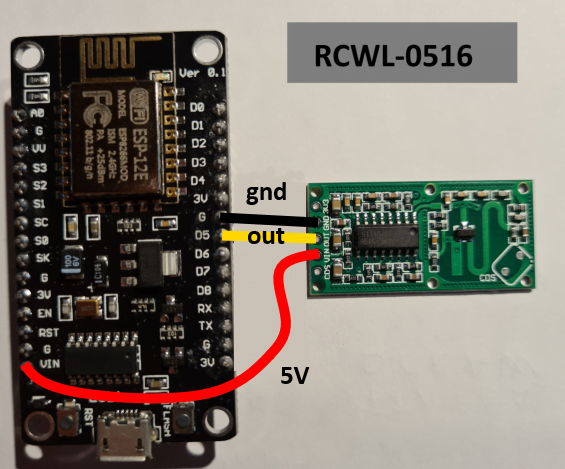
And the sample code for the RCWL-0516 microwave sensor:
#include <ESP8266WiFi.h>
#include <PubSubClient.h>

const char* ssid = "SSID";
const char* password = "PASSWORD";
const char* mqtt_server = "192.168.X.XXX";

int  DetectionPin = D5;
bool Detection = false;
bool previousDetection = false;


WiFiClient espClient;
PubSubClient client(espClient);


void reconnect()
{
  while (!client.connected())
  {
    String clientId = "ESP8266_Radar";

    if (client.connect(clientId.c_str()))
    {
      // pass
    }
    else
    {
      delay(6000);
    }
  }
}

void setup()
{
  WiFi.mode(WIFI_STA);
  WiFi.begin(ssid, password);
  while (WiFi.status() != WL_CONNECTED)
  {
    delay(500);
  }
  client.setServer(mqtt_server, 1883);
  pinMode (DetectionPin, INPUT);
}

void loop()
{
  if(!client.connected())
  {
    reconnect();
  }
  client.loop();

  Detection = digitalRead(DetectionPin);

  if(Detection == true)
  {
    if(previousDetection == false)
    {
      client.publish("motion", "true");
      previousDetection == false;
    }
  }
  else
  {
    if(previousDetection == true)
    {
      client.publish("motion", "false");
      previousDetection == false;
    }
  }
}
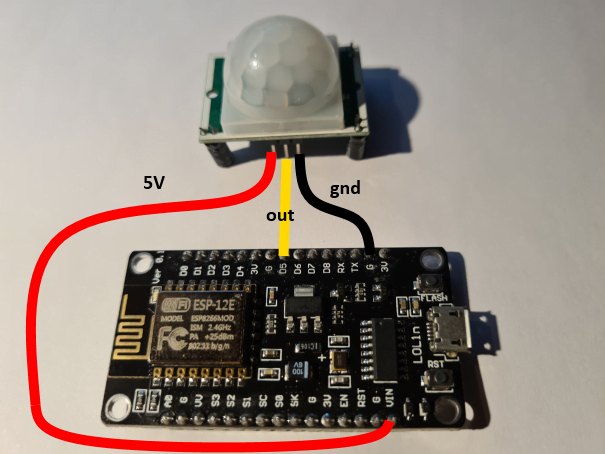
You can also replace the RCWL-0516 with the PIR sensor HC-SR501. Don’t forget to change the code, however, as the HC-SR501’s output will be low when motion is detected and therefore the opposite of how our radar sensor works.
We will see:
#include <ESP8266WiFi.h>
#include <PubSubClient.h>

const char* ssid = "SSID";
const char* password = "PASSWORD";
const char* mqtt_server = "192.168.X.XXX";

int  PirPin = D5;
bool Detection = false;
bool previousDetection = false;


WiFiClient espClient;
PubSubClient client(espClient);


void reconnect()
{
  while (!client.connected())
  {
    String clientId = "ESP8266_HC-SR501_PIR";

    if (client.connect(clientId.c_str()))
    {
      // pass
    }
    else
    {
      delay(6000);
    }
  }
}

void setup()
{
  WiFi.mode(WIFI_STA);
  WiFi.begin(ssid, password);
  while (WiFi.status() != WL_CONNECTED)
  {
    delay(500);
  }
  client.setServer(mqtt_server, 1883);
  pinMode (PirPin, INPUT);
}

void loop()
{
  if(!client.connected())
  {
    reconnect();
  }
  client.loop();

  Detection = digitalRead(PirPin);

  if(Detection == false)
  {
    if(previousDetection == false)
    {
      client.publish("motion", "true");
      previousDetection == false;
    }
  }
  else
  {
    if(previousDetection == true)
    {
      client.publish("motion", "false");
      previousDetection == false;
    }
  }
}
The connection is as follows: